 Maverick
Maverick liquidity modes control whether bins stay fixed or follow price movements
Maverick liquidity modes determine whether liquidity stays at chosen prices or follows eligible price movements within a pool. Static keeps bins fixed, Right follows rising prices, Left follows falling prices and Both follows either direction. These rules reposition trading liquidity; swaps can still change the tokens a position holds. The choice therefore affects inventory exposure as well as time spent near trading activity. Positions in one-way modes can incur impermanent loss when a trend reverses. Both can repeatedly exchange inventory during reversals and lock in losses even when price later returns. Bin placement, pool configuration and the actual price path determine how each choice behaves.
- last updated
Bin Movement and Token Exposure
Moving bins relocates the price ranges where their liquidity can trade, bringing eligible reserves closer to price without requiring a manual repositioning transaction. A bin represents liquidity within a bounded price interval. As swaps pass through that interval, they change its token composition. Beyond either edge, liquidity can consist entirely of one pool token. Automatic movement can then relocate compatible single-token liquidity without exchanging it merely to change its price location.
Pool price expresses the base token’s value in quote tokens. Right means that relative price rises; Left means it falls. This direction concerns the pair, independently of either token’s price in another currency. Trading fees arise when swaps use the position’s liquidity, so a nearby bin can remain idle between trades.
Static Placement and Directional Tracking
The four modes specify different movement rules, while initial bin placement determines the inventory a position supplies to those rules.
Mode Static
Mode Static keeps liquidity at its chosen price intervals. It suits a fixed allocation across prices, including uneven distributions. Flat spreads liquidity evenly across selected bins; Exponential concentrates more around the center with decreasing amounts farther away. Single Bin concentrates the allocation into one interval. Leaving the selected range stops that liquidity from participating in swaps until price returns or the allocation changes.
One-Way Movement
Mode Right
Mode Right moves eligible bins toward higher prices and leaves them in place during downward movement. Its usual directional placement holds quote tokens immediately below the active range. As price rises, reconcentration keeps that liquidity nearby. Downward retracements can bring trading into its bin and generate fees. Holding quote tokens in this configuration does not automatically capture the base token’s appreciation.
Mode Left
Mode Left follows eligible downward movement without following price upward. Its usual directional placement holds base tokens immediately above the active range. Rising retracements can bring swaps into that liquidity during a broader downward trend. The mode tracks a falling relative price while the position remains exposed to its current token holdings between trades.
Mode Both
Mode Both permits movement in either direction. It can serve strategies seeking liquidity near a relatively stable trading relationship with smaller fluctuations. The position can change sides after trades convert its inventory through a price interval. Repeated large reversals create a different loss exposure from one-way tracking.
What Happens When the Price Reverses?
A sustained reversal can trade directional liquidity into the underperforming asset, while bidirectional reconcentration can crystallize losses across repeated changes of direction.
Falling price can exchange a Right position’s quote tokens for base tokens as swaps cross its bins. Right will not move those bins downward. Left has the mirrored exposure: rising price can exchange base tokens for quote tokens without upward tracking. The loss comparison uses the tokens originally deposited and their value if held outside the pool.
Mode Both can incur permanent loss when repeated reversals make the position buy high and sell low. Following a reversal, trades can fully convert the position’s inventory before the automated market maker (AMM) reconcentrates that liquidity to follow the reversed price trend. Further reversals can repeat that conversion at unfavorable relative prices. Returning to an earlier price does not necessarily restore reserves lost through those cycles. Impermanent loss, by comparison, measures divergence from holding and can shrink when relative prices recover. These are different effects, and a larger fee balance does not establish that either loss has disappeared.
Small retracements can generate fees for directional positions. Whether those fees cover adverse inventory changes depends on the actual trading volume and price path.
TWAP Timing and Pool Constraints
The pool’s time-weighted average price (TWAP), bin eligibility and swap activity govern automatic movement, so a brief spot-price jump need not relocate liquidity. TWAP smooths the pool’s price history and can lag its spot price. The contract checks movement conditions during swap processing. A pool’s lookback setting shapes the response rather than establishing a universal waiting period. Without relevant swap activity, passing time alone does not execute a bin shift.
V2 pools can permit a subset of the protocol’s modes, so the selected pool must support the intended choice. Movement rules also restrict which bins can relocate. Liquidity outside the eligible movement region can remain stranded until applicable price conditions return.
Read a Rightward Bin Shift
A higher recorded tick confirms that an eligible Mode Right bin has relocated to a higher price range. A tick identifies a price interval in V2 accounting.
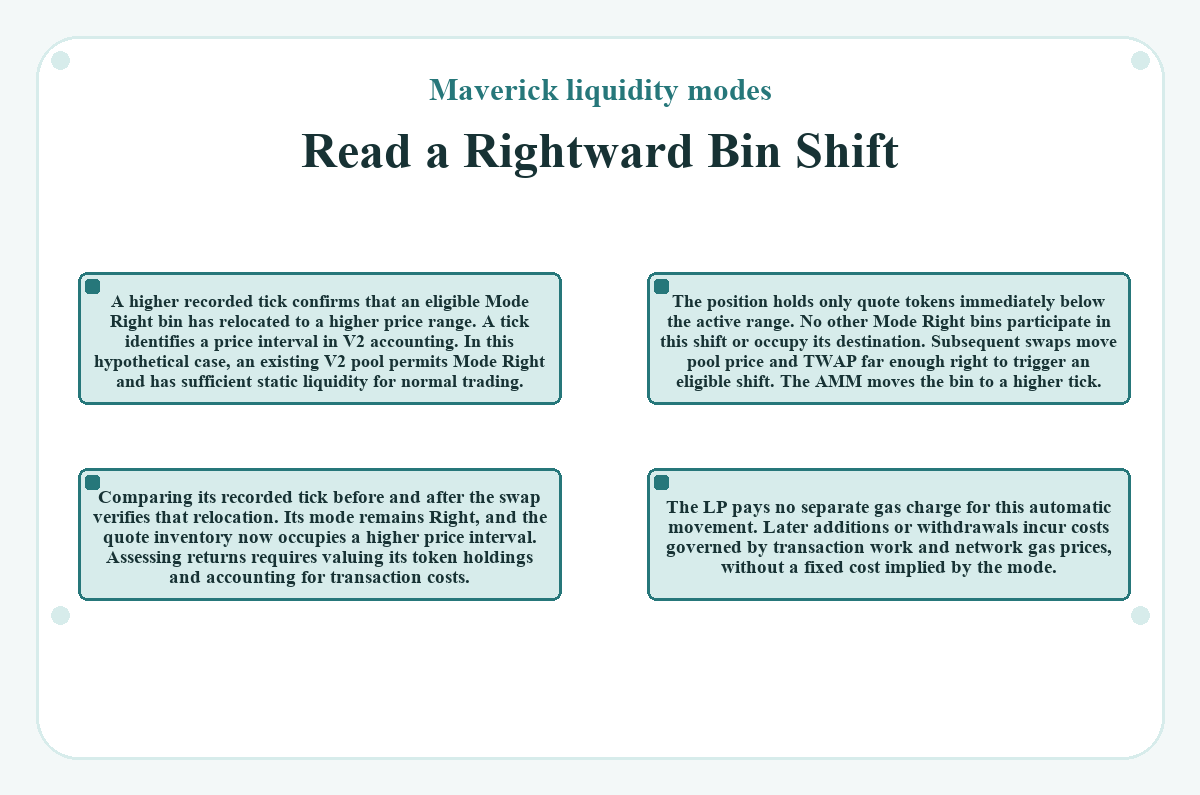
In this hypothetical case, an existing V2 pool permits Mode Right and has sufficient static liquidity for normal trading. The position holds only quote tokens immediately below the active range. No other Mode Right bins participate in this shift or occupy its destination. Subsequent swaps move pool price and TWAP far enough right to trigger an eligible shift.
The AMM moves the bin to a higher tick. Comparing its recorded tick before and after the swap verifies that relocation. Its mode remains Right, and the quote inventory now occupies a higher price interval. Assessing returns requires valuing its token holdings and accounting for transaction costs. The LP pays no separate gas charge for this automatic movement. Later additions or withdrawals incur costs governed by transaction work and network gas prices, without a fixed cost implied by the mode.
Trading Fees and Range Width
Trading fees depend on swaps through supplied liquidity and the position’s proportional ownership, while range width changes how the deposit supports those trades. Maverick reinvests earned trading fees into pool reserves. An idle allocation does not earn trading fees merely because it uses a moving mode. Fee rates and trading demand belong to the selected pool, and movement alone supplies no fixed return.
Bin width sets each price interval’s size; distribution width describes the overall span an allocation covers. With a fixed deposit, a wider Flat distribution spreads liquidity more thinly across its covered intervals. Wider bins can require larger price swings before Mode Both’s reconcentration losses arise. They also change trading exposure, so width cannot establish profitability on its own.
Static Liquidity and Shared Strategies
Static liquidity supports price discovery and arbitrage around moving positions, helping the pool maintain the trading conditions those movement rules need. Thin static reserves can make unwanted movement through price manipulation easier. Arbitrage must offer enough value to justify its transaction cost; the necessary depth depends on pool conditions and network costs. V2’s movement design reduces some manipulation exposure, while adequate static depth remains relevant.
Boosted Positions package preset liquidity arrangements other providers can join, including arrangements using a movement mode. Their underlying bins retain the same inventory and reversal exposures. Staking the position’s share tokens for incentives is a separate reward mechanism. Additional rewards contribute to the overall return calculation. The selected mode still determines movement, and its price path can still cause losses.
What to know about Maverick liquidity modes
-
Why Can Mode Right Require Both Pool Tokens?
- Mode Right can require both tokens when the selected distribution includes liquidity in the active price interval. The required token mix follows the bins and their reserves, not just the mode name. Quote-only placement below the active range is one configuration; adding active-range liquidity changes the funding requirement. A directional mode does not impose a universal single-token deposit.
-
How Are Liquidity Modes Encoded in Maverick V2 Calls?
- Maverick V2 encodes a bin’s kind as 0 for Static, 1 for Right, 2 for Left and 3 for Both. The pool’s supported-modes setting uses a bitmask instead. Its individual flags are 1, 2, 4 and 8 respectively. These fields represent different things, so a kind identifier cannot substitute for the corresponding supported-mode flag.
-
Can Moving Bins Merge With Other Liquidity?
- Moving bins can merge when liquidity of the same mode converges at the same tick. V2 retains a surviving bin and tracks the merged bin’s claim through its merge reference. A merge combines compatible liquidity and keeps a claim to the surviving bin’s reserves. A historical bin identifier can therefore refer to liquidity now associated with a surviving bin.
-
Does a Position NFT Force Every Bin to Use the Same Mode?
- A Maverick V2 position NFT can hold claims to bins with different modes. Each bin’s own kind controls its movement, while the NFT identifies the subaccount holding those bin claims. Combining those claims under one NFT does not make Static bins move or give Right bins permission to follow falling prices.
-
Will Withdrawal Refund Reserves Lost Through Mode Both?
- Withdrawal redeems the position’s prevailing share of pool tokens without reimbursing earlier reconcentration losses. Those losses can already affect reserves before withdrawal. The returned assets reflect the inventory trading has left in the position, including its share of accrued trading fees. They need not match the original token amounts or the original token mix.
-
Is a Sale Through a Static Bin Final Once Price Crosses It?
- A static bin can swap back into its original asset if price reverses while its liquidity remains in the pool. This matters when fixed liquidity mimics a limit order. Trading through the interval converts inventory, but continuing to supply that inventory leaves it available for reverse trades. A completed swap does not close the liquidity position.
-
What Happens to Fees When Different Modes Share a V2 Tick?
- V2 aggregates reserves at the tick level and gives each constituent bin a proportional claim to those reserves. The portion of trading fees retained for LPs increases those reserves. Different modes at the same tick can therefore participate in the same trading activity. Their distinction concerns subsequent movement, rather than a separate promised fee yield for each mode.