 Maverick
Maverick staking - Lock End Dates and Voting Power
Maverick staking gives MAV lock holders veMAV voting power while keeping their underlying tokens in a voting-escrow contract. veMAV is a non-transferable governance token. The deposited MAV remains unavailable for withdrawal until its lock expires. A later end date increases the multiplier used to calculate voting weight. That multiplier uses the time between the contract’s start timestamp and the lock’s end. More voting power does not establish a fixed token return. Incentive eligibility follows separate rules. New V2 stakes, extensions of existing locks and synchronization of legacy stakes also involve different requirements.
- last updated
Extending a MAV lock increases voting power while postponing the date when the underlying tokens become eligible for redemption.
MAV Deposits and Recorded Lockups
An eligible MAV deposit needs an accepted staking duration, sufficient tokens and any required spending allowance on the same chain as the voting-escrow contract. MAV provides the principal, while veMAV records governance weight. The V2 lockup stores the MAV amount, an end timestamp and associated votes. Its voting balance can exceed the deposited amount because the balance measures voting power. It does not describe extra MAV available for redemption.
Each stake has an identifier within its account and contract. The staking preview describes a proposed lock; the committed lockup and its Stake event describe an executed deposit. The V2 voting-escrow lens exposes claim information for the account and selected incentive batches. That read describes an entitlement under the batch’s rules, without establishing a completed payout. A staking amount, a veMAV balance and an incentive claim therefore describe different objects.
Voting Rights and Incentive Eligibility
veMAV supports governance voting. In the V2 veFlywheel, holders can use veMAV votes to influence emissions for eligible Boosted Positions, subject to the voting rules. Holding veMAV can also boost a liquidity provider’s MAV emissions from those positions. Staking those emissions can provide a separate boost. Depositing MAV does not itself create a liquidity position or select its liquidity modes. Those modes govern how pool liquidity moves, independently of a MAV lock’s end date. Separately, voting-escrow incentive batches allocate token rewards using holders’ historical veMAV balances. In V2, MAV batches requiring a staking duration lock the claimed rewards. Batches with no staking requirement transfer the rewards to the claimant; non-MAV batches must use this form. Participation in one mechanism does not establish an entitlement under another.
How Does a Lock End Date Determine veMAV?
Maverick’s staking multiplier increases with the interval between the contract’s start timestamp and the chosen lock end, so equal-duration stakes can receive different weights. Expressed in years, the relationship is multiplier = 1.5^t, where t measures that interval. The lock’s veMAV balance equals its deposited MAV multiplied by this factor. Moving the end one additional year forward multiplies voting weight by 1.5 for the same principal. This factor measures voting units, not annual interest.
Equal MAV amounts with the same end timestamp receive the same multiplier within the same escrow contract. Different deposit dates do not change that shared end-date calculation. Choosing the same duration at a later staking date produces a later expiry. Its multiplier then rises because the contract measures a longer interval from its start. Comparing stake lengths without comparing expiry dates misses this part of the calculation.
Extending a MAV lock to a later end date increases its veMAV multiplier. An extension also moves the principal’s redemption date. The maximum permitted duration constrains a new lock or extension relative to execution time. It does not place every stake at one shared calendar deadline. The proposed expiry therefore matters when reviewing an extension, even if the deposited MAV amount stays unchanged.
New stakes with later end dates can reduce an unchanged lock’s share of total voting power.
A Hypothetical Stake With a Duration Boundary
In this hypothetical example, a holder selects 135 MAV and a staking duration within the contract’s permitted range. Assume the wallet has sufficient MAV, the required spending allowance and gas funds. The holder accepts the resulting lock period and wants the contract to record that principal.
The duration must satisfy the contract’s bounds when staking executes. The holder reviews the preview, then submits the staking action. The committed lockup records 135 MAV, its execution-derived end timestamp and the corresponding veMAV weight. The holder checks the recorded amount and end timestamp against the intended deposit, without relying on a reward forecast.
If the holder instead requests a hypothetical term below the contract’s minimum, the preview rejects it. The holder chooses an eligible term and obtains a fresh preview before submitting. Extra MAV cannot correct this timing error. The duration rule governs the lock’s term, so changing a token allowance would address a different requirement.
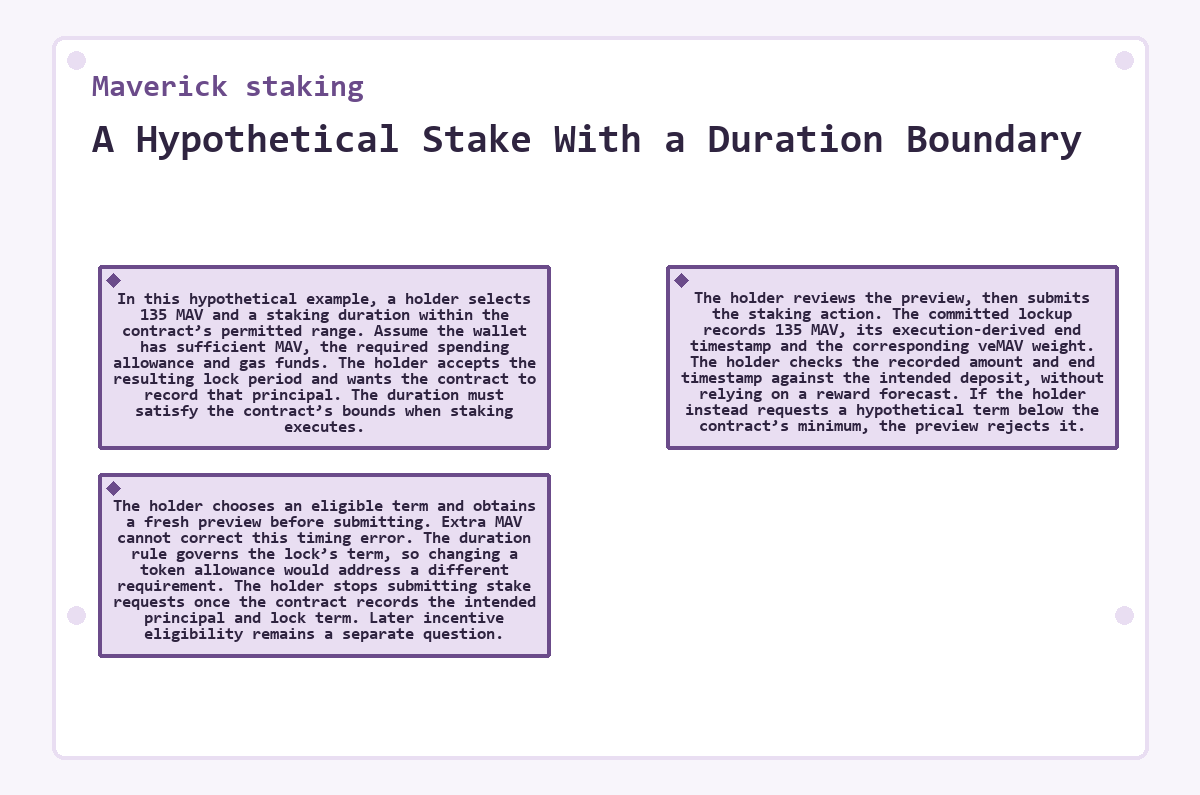
The holder stops submitting stake requests once the contract records the intended principal and lock term. Later incentive eligibility remains a separate question.
V1 Locks and V2 Synchronization
V1 veMAV needs synchronization before it can participate in the V2 veFlywheel, even when a management screen already displays the underlying stake. The synchronized balance lets V2 recognize that legacy voting power. Synchronization does not itself redeem the original MAV. The legacy escrow continues to govern the principal’s lock, so the original deposit and its V2 recognition remain distinct.
Eligibility rests on the legacy lock’s remaining term. For an unredeemed legacy lock, the synchronization contract requires its end timestamp to reach at least the execution timestamp plus MIN_SYNC_DURATION. The documented synchronization contract sets that interval to 365 days. A shorter remaining term requires extension before synchronization. This rule differs from the ordinary minimum for creating a new V2 stake. The voting-escrow lens exposes legacy lock details and synchronized balances, making each stake’s synchronization status separately readable.
When Can Locked MAV Be Withdrawn?
MAV becomes redeemable when the selected lock reaches its recorded end timestamp, and the holder still needs to execute an unstaking action. Expiry establishes eligibility, while redemption returns the principal. The contract burns the veMAV associated with the redeemed lock. For a synchronized V1 lock, a further synchronization clears its corresponding V2 balance. Other unredeemed stakes keep their own principal and end dates. An expired entry on a management screen therefore does not mean the tokens have already returned to the wallet.
An extension moves the withdrawal boundary for the affected lock. Until that boundary arrives, changes in MAV’s market price do not release its principal. A voting multiplier describes how much governance weight a lock creates; it does not increase the MAV amount the original deposit contains. The holder retains exposure to MAV’s changing market value throughout the commitment, including periods when withdrawal remains unavailable.
Keeping MAV in a wallet preserves its transferability. Staking commits it to delayed redemption in exchange for veMAV voting power.
Useful questions about Maverick staking
Can I Delegate veMAV Without Transferring My MAV?
Delegating veMAV changes who exercises its voting power while you retain ownership and redemption rights over the underlying MAV. The delegate receives voting authority, without taking custody of the deposit. You can redirect the voting power to yourself or another address. Delegation also leaves the lock’s expiry unchanged.
Does Adding MAV Change an Existing V2 stake’s End Date?
V2 supports adding MAV while retaining a stake’s end date if at least four weeks remain when the transaction executes. With less time remaining, adding MAV requires extending the lock. The additional principal increases the associated veMAV balance. Extending the term is a different change because it postpones redemption. The Add feature applies to V2 stakes; the documented interface does not offer it for V1 stakes.
Why Can My veMAV Balance Differ From My Delegated Voting Power?
Your veMAV balance measures the voting-escrow tokens you own, while delegated voting power measures the votes assigned to an address. Sending your delegation elsewhere can reduce the votes you exercise without reducing ownership. Receiving delegation can increase your voting authority without adding MAV to your own lock. Balance reads and delegated-vote reads therefore answer different questions.
Are one-week MAV Locks Possible Through the Staking Contract?
The legacy V1 MAV escrow permits one-week locks, while V2 requires at least four weeks. Both versions have a maximum duration of four 365-day years. The dApp presents a simplified set of duration choices, so its shortest preset does not define the contract’s minimum. A staking transaction must satisfy the bounds of the selected escrow contract when it executes.
What Does a Zero Claimable Incentive Amount Mean for My MAV Stake?
A zero batch claim amount means the read shows no incentive amount for the selected account and batch. It does not by itself establish that the MAV deposit failed. Related claim fields distinguish whether the timepoint has passed and whether the account has already claimed. Entitlements use historical balances, so a present veMAV balance alone cannot establish eligibility for an earlier allocation.
Can Another Address Extend My V2 MAV Lock?
V2 supports approved extenders for specific lockups. The approveExtender function grants that permission, while revokeExtender removes it. An approved extender can postpone the selected lock’s redemption date. It differs from delegating governance votes, which leaves the underlying lock’s redemption rights with its owner.
Does a Stake Identifier Refer to the Same Lock Across Chains?
A stake identifier has meaning within a particular account and staking contract. Different chains can assign the same number to separate stakes. The owner address, chain and contract version provide the rest of its context. This distinction matters when a management screen lists legacy and V2 entries together.